2025–
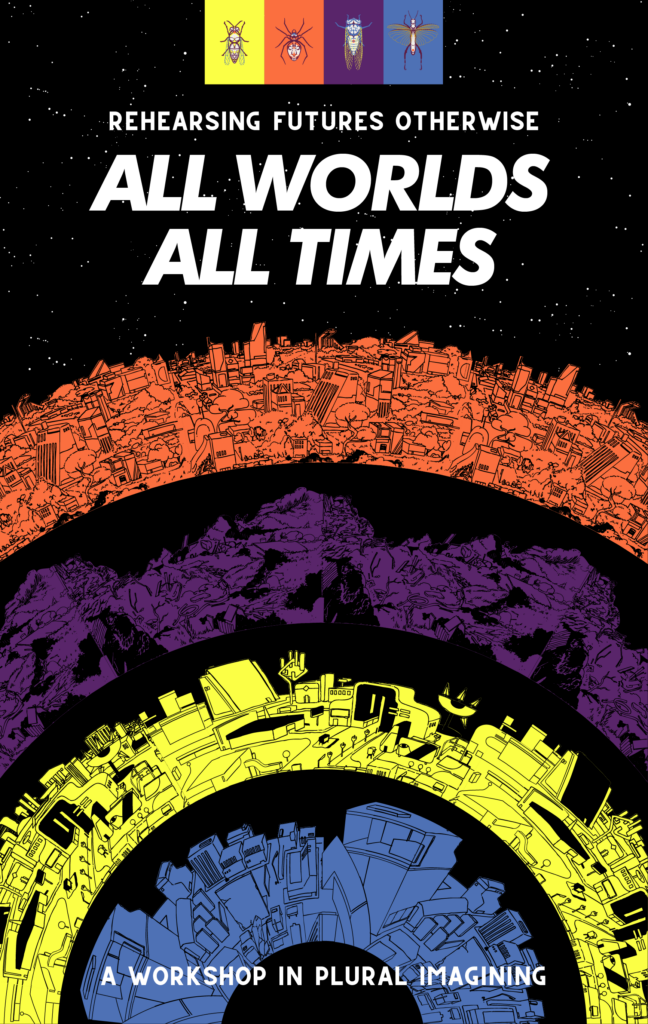
All Worlds, All Times uses playful performance to bring varied groups into structured future scenarios, where diverse experience, imagination, and expertise meet questions on the discovery of life beyond Earth.
Project summary.
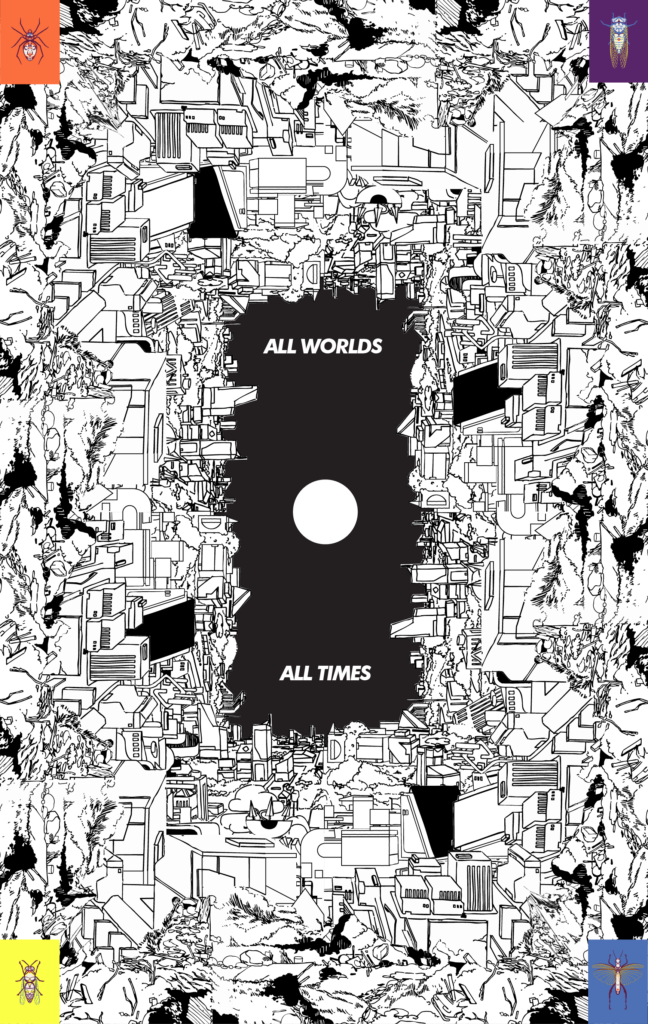
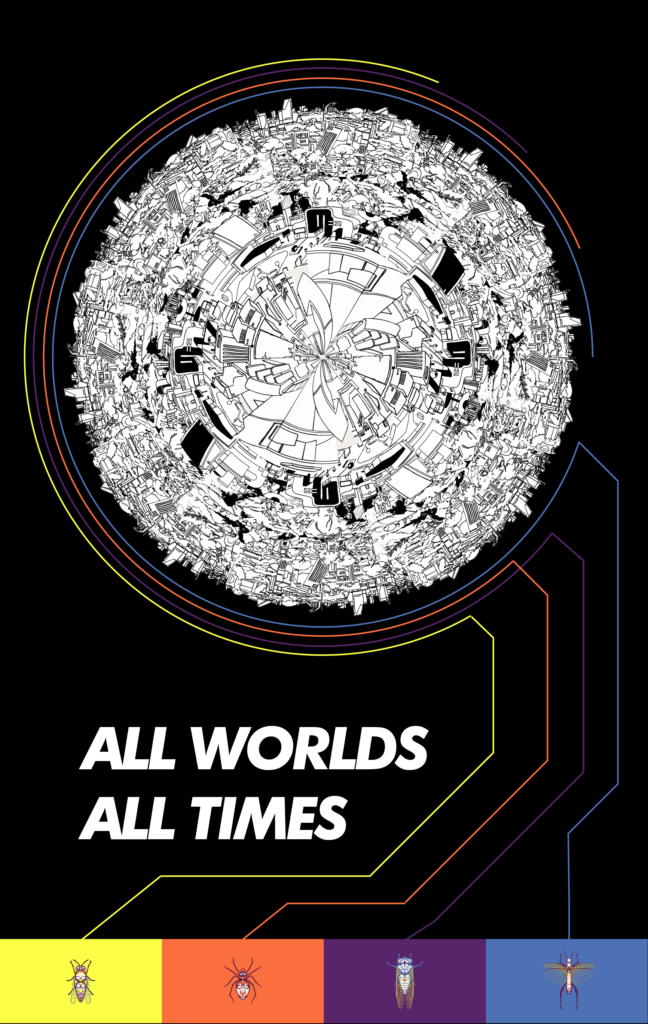
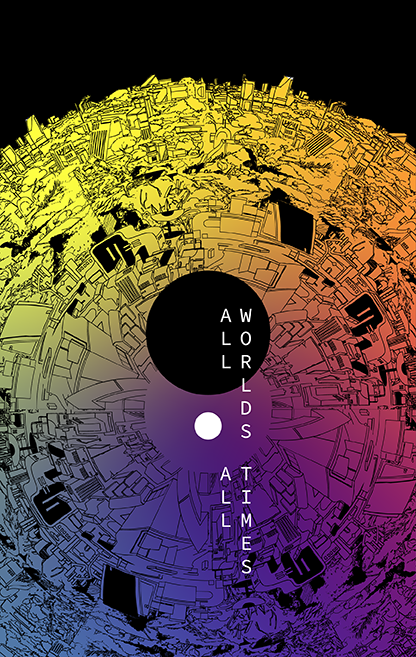
All Worlds, All Times, a performance workshop exploring speculative technosignature assessment and the unknowns at play in the discovery of life beyond earth. Created by Theresa Fisher, Kate Genevieve, Angelica Kovačević, in response to the Post-Detection Scenarios Toolkit (George Profitiliotis et al.) with additional input from Diana Solano-Oropeza, Edward Males, and members of the SETI Post-Detection Hub and the SETI ECR network, the Order of the Octopus. Illustration by Will Scobie. Sound by Adam Freeland. Published under the Creative Commons Attribution–NonCommercial–ShareAlike 4.0 International (CC BY-NC-SA 4.0).
Project Delivery.
All Worlds, All Times invites an audience to explore future scenarios through structured improvisation that tackle questions for astrobiology and the search for extraterrestrial intelligence (SETI). Alongside the live event, activities include workshops, performances, public events, walks, zines, and scenario cards. The project is delivered through exhibitions and conferences, and via touring formats, with an emphasis on analogue workshops outdoors, and with the possibility of online sessions to extend access to more participants.
Players.
This performance workshop is designed for 10–24 participants (ages 18+). It is not only for experts. All Worlds, All Times is designed for mixed groups, and works especially well when people from different backgrounds play together, including members of the public.
The participants are co-creators of the performance. The audience mix may include scientists across disciplines, observatory and aerospace professionals, media and communication workers, international governance and technology policy-makers, social scientists and designers, ecologists and technologists, and anyone interested in broadening approaches to the discovery of life beyond Earth.
What is a performance workshop?
Live-action roleplay is employed as a futures method: active rather than abstract, the workshop offers a way to think together through collective improvisation that engages with many worlds through the involvement of a mix of people, relationships and constraints
The approach draws on the Mānoa School of Futures Studies and the landmark Hawaii 2000 project in the 1970s, which explored then-emerging communications technologies to include communities across the islands in imagining alternative futures, and helped popularise scenario role-play using four very different archetypal futures.
Futures performance research contributes to readiness by “rehearsing” different futures through collective participation. This kind of work builds on long-standing research traditions that insist science is never neutral, including Latin American anthropology, Indigenous Research and Black feminist praxis, feminist technoscience and STS. These lineages connect across solidarities and stand with those that are too often marginalised in science: welcoming people into relation across differences, refusing demands for ideological or cultural homogeneity. When political pressure encroaches on the practice of science with ideological controls and exclusions, playful research and creative worlding opens an alternative path that celebrates plurality, dignity, respect and friendliness as healthy conditions for knowledge-making.
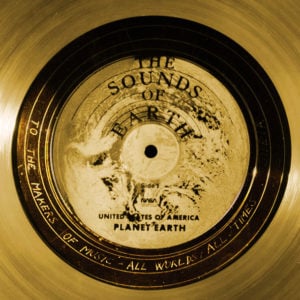
NASA’s 1977 Voyager Missions
In 2012, Voyager 1 crossed the heliopause, the first human-made object to travel beyond the heliosphere, opening an interstellar chapter in space exploration; Voyager 2 followed in 2018.
The Golden Record
The Golden Record’s diverse mix of content carries a proposition about what future science could be: imaginative, rigorous, plural and open to wonder.
To the Makers of Music—all worlds, all times
Our LARP takes its title from the engraved dedication on the Golden Record itself.
Open NASA “Eyes on the Solar System” (Voyager tracking)
NASA: Where are Voyager 1 & 2 now?
Post-Detection Toolkit
The scenarios used explore the SETI Post-Detection Hub’s open-source toolkit. Over two years of extended strategic foresight, the Scenarios Working Group (led by futures researcher George Profitiliotis) developed scenarios not as predictions or ideal endpoints but as worlds with trade-offs, attentive to multispecies standing and to the influence of AI on the media landscape.
The project works with an open, remixable scenario resource created for the SETI community by the SETI Post-Detection Hub, alongside a growing shared imaginative wiki: a commons resource that can be critiqued, adapted, and extended. The core pre-detection scenario framework is released as open source under an educational licence (Profitiliotis et al.).
But… Why?
Futures research is anticipatory intergenerational education. Through collective improvisation and performative systems, researching how sense-making happens under uncertainty can draw out relational patterns and emerging dynamics in the participation of groups. Such work can inform decisions and policies today, while supporting those responsible for tomorrow to learn and plan with plural futures in mind.
The emergent field of post-detection approaches today’s shifting communication ecologies pragmatically and speculatively: researching media and communication at planetary scale to gauge future potentials, whilst reframing foundational questions: how might life be recognised, and how can communication be understood across ecologies and technologies on a more-than-terran frame?
Performance, through welcoming “live” participation, makes relational discovery and decision-making visible in real time. These human elements of response and readiness are what the ecologist Nora Bateson calls “warm data”: the contextual texture that formal models often miss. To study communication in practice is to include miscommunication, and the full range of human responses that shape it: excitement, fear, freezing, certainty, caution, and error.
Futures performance research contributes to readiness by “rehearsing” different futures through collective participation. This kind of work builds on long-standing research traditions that insist science is never neutral, including Latin American anthropology, Indigenous Research and Black feminist praxis, feminist technoscience and STS. These lineages connect across solidarities and stand with those that are too often marginalised in science: welcoming people into relation across differences and refusing demands for ideological or cultural homogeneity. Playful research and creative worlding opens alternative paths for science that celebrate plurality, dignity, respect and friendliness as healthy conditions for knowledge-making.
The work is designed with consent and safety protocols and transparent participant briefing, so that people can choose their level of involvement with information about what to expect. The project uses ongoing participant feedback to keep growing and refining design, governance, collaboration and consent practices. We welcome feedback and critique and see the project as a resource and practice evolving with and for a transdisciplinary research community.
With thanks to initial development by Kate Genevieve (chroma.space), John Elliott (SETI Post-Detection Hub), Ruth Catlow (Furtherfield), and Arik Kershenbaum (University of Cambridge), and to Benjamin Fields and Emily Finer for their valuable facilitation in previous showings.